


Commercial alarm systems trigger false alerts in summer heat because the passive infrared (PIR) sensors used in most commercial motion detectors rely on detecting heat differentials, and those differentials narrow as ambient temperatures rise. When the gap between background air temperature and body temperature shrinks, PIR sensors become more susceptible to false triggers from sunlit surfaces, HVAC cycling, thermal expansion at door contacts, and hot air currents. M.R. Electricians has served DMV commercial clients with security system electrical infrastructure since 1996. Read verified reviews on Google and Yelp, view our Better Business Bureau profile, and learn about our commercial team before you call. This guide explains every cause and what resolves each one.
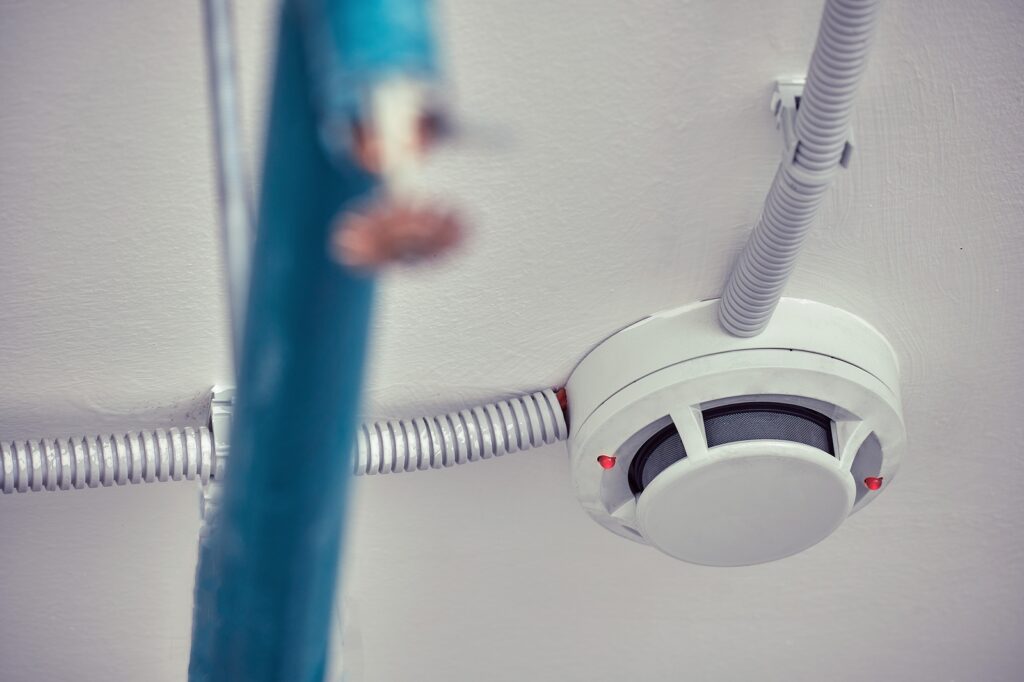
How PIR Sensors Work and Why Summer Changes the Equation
Passive infrared sensors detect motion by measuring rapid changes in the infrared radiation pattern within their detection zone. They do not generate energy; they passively receive it. The sensor is calibrated to recognize the specific thermal event of a warm human body moving through a space that is cooler than the body, producing a rapid change in the infrared pattern across the detection zone that triggers an alarm signal.
In a commercial space during winter or in a well-air-conditioned office in spring, the gap between ambient air temperature and human body temperature is typically 25 to 40 degrees Fahrenheit. A PIR sensor calibrated for this differential reliably distinguishes a person from the background. In peak summer heat, particularly in commercial spaces with large window exposure, delivery bays that open to outdoor air, or cooling systems that cannot maintain interior temperatures below 80 degrees Fahrenheit, the gap between ambient temperature and body temperature narrows to 10 to 15 degrees or less. At that differential, the sensor can no longer cleanly distinguish a human from a sunlit floor, a puff of warm air from an opened door, or an HVAC unit starting its cooling cycle.
Six Causes of Summer Heat False Alarms in Commercial Security Systems
1. Narrowed Thermal Differential in Hot Commercial Spaces
The core heat problem described above affects every PIR sensor in the building when ambient temperature rises. Spaces that are hardest hit include south-facing offices with large window areas, retail spaces with high ceiling heights and inadequate cooling, warehouses where large rolling doors admit hot exterior air, and restaurant kitchens where cooking heat contributes to elevated ambient temperatures. In these environments, false alerts are most common during peak afternoon hours from approximately 2 PM to 6 PM, when ambient temperature reaches its daily maximum and the thermal differential PIR sensors depend on is at its narrowest.
2. HVAC System Cycling Creating Rapid Temperature Changes
When a commercial HVAC system starts a cooling cycle, it rapidly introduces cold or cool air from supply registers into zones of warmer ambient air. This creates an abrupt temperature differential that moves across the space as the cooler supply air spreads through the room. A PIR sensor near a supply register or in the direct path of supply air flow registers this rapid temperature change as a potential thermal event. Spaces where cooling systems cycle frequently because they are struggling to maintain setpoint temperature in summer are particularly prone to this false trigger pattern, and it tends to recur at regular intervals matching the cooling cycle timing.
3. Direct Sunlight Moving Across PIR Sensor Detection Zones
South- and west-facing commercial spaces with large windows allow direct sunlight to move across the floor and walls during afternoon hours. The leading edge of a sunlit patch on a concrete or tile floor can be 20 to 30 degrees warmer than the adjacent shaded surface. As sunlight moves, this warm leading edge crosses PIR detection zones as a moving thermal event. Some PIR sensors register this progression as human motion. South-facing retail fronts, open-plan offices with floor-to-ceiling windows, and spaces with skylights are the most common locations for this pattern of false alerts.
4. Thermal Expansion at Door and Window Contact Sensors
Door and window magnetic contact sensors generate a false alarm when the two magnetic components move far enough apart to break the circuit that signals the zone as secured. Summer heat causes thermal expansion in door frames, window sashes, and door panels, which can shift the position of contact sensor components relative to each other. A door or window that held contact correctly in its cooler contracted state during winter may gap enough during peak summer afternoon heat to break the magnetic contact, generating a false alarm that is logged as the door or window opening. This pattern typically occurs at predictable times aligned with peak afternoon temperature and may improve by early evening as temperatures moderate.
5. Insects Entering or Contacting Sensor Lenses
Summer insect activity increases around commercial buildings, and insects are attracted to the warmth and infrared emission of electronic sensor housings. An insect crawling across a PIR sensor lens generates a close-range infrared event that the sensor reads as motion. This produces brief, isolated false alarm triggers rather than the sustained or pattern-matched false alerts associated with thermal or HVAC causes. Cleaning sensor lenses as part of a summer security system maintenance check and sealing any gaps in the building envelope that allow insects to reach indoor sensors are both part of summer-specific security system upkeep.
6. Aging Sensor Components with Degraded Thermal Calibration
PIR sensors have rated service lives, and aging optical elements, degraded Fresnel lenses, and deteriorated electronic components all contribute to less precise detection behavior. A sensor that functioned reliably during previous summers may develop heat-related false trigger problems as it ages because its detection thresholds and optical quality have degraded to the point where marginal summer conditions now exceed its tolerance. Commercial security systems that have not been professionally inspected in five or more years may have multiple aging components whose marginal performance only becomes apparent under summer heat conditions. Our commercial preventive maintenance service includes security system electrical infrastructure inspection that identifies aging components before they produce operational problems.
Warning Signs That Confirm Heat Is the Cause
- False alerts occur consistently in the afternoon hours from 2 PM to 6 PM, not randomly across the day.
- The same sensor or the same zone generates repeated false alerts while others remain quiet.
- False alert frequency increases during heat waves and decreases on cooler days or after rain that lowers outdoor temperatures.
- Reviewing the alert log shows false triggers correlated with HVAC cycle timing, specifically at the moment cooling cycles initiate.
- The false alerts began or worsened during the current summer, not during the same period in previous years, suggesting a change in conditions or equipment aging.
- Door or window contact false alarms occur in the mid to late afternoon and are not present in morning hours when the building is cooler.
DIY vs. Professional: What Business Owners Can and Cannot Address
Business owners can review alert logs to identify patterns and document the timing and frequency of false alerts before calling a security system professional. They can also check whether any sensors are positioned directly in front of supply air registers or in direct sunlight paths that could be addressed by moving furniture or adding window coverings. These observations provide useful diagnostic information.
Adjusting sensor sensitivity settings, replacing PIR sensors with dual-technology units, repositioning sensors, recalibrating contact sensor placement, and addressing the electrical wiring infrastructure of a commercial security system all require licensed professional work. NFPA 731, the Standard for the Installation of Electronic Premises Security Systems, governs the installation requirements for commercial alarm and security system wiring. Commercial security and alarm system wiring also falls under National Electrical Code requirements and state licensing standards. For the electrical infrastructure component, including wiring integrity, connection quality at sensor terminals and control panels, and backup power assessment, M.R. Electricians provides licensed commercial electrical support. Visit our commercial security system electrical service for details on what we address in commercial security infrastructure assessments.
Solutions That Directly Address Each Cause
- Replace PIR-only sensors at problem locations with dual-technology sensors that require both PIR and microwave detection to agree before triggering. This single change addresses the majority of heat-related false alert problems at the sensor level.
- Relocate sensors away from HVAC supply registers, direct sunlight paths, delivery door proximity, and kitchen heat discharge areas. Sensor placement that was acceptable when the system was installed may have become problematic as building use or layout changed.
- Adjust contact sensor sensitivity at door and window zones or reposition contact components to account for summer thermal expansion. In severe cases, replacing sensor pairs with components designed for higher-temperature commercial environments is the appropriate correction.
- Clean all sensor lenses and housing exteriors as part of a dedicated summer maintenance inspection. Accumulated dust, insect debris, and salt residue (particularly in Pinellas County coastal locations) on sensor lenses degrade detection reliability.
- Inspect the electrical wiring infrastructure at each sensor, at the control panel terminal connections, and through any conduit runs that may have experienced thermal expansion that loosens connections. Our commercial security system page and fire alarm systems service cover the electrical scope of commercial security infrastructure support.
DMV Summer Heat and Commercial Security Systems in Rockville, Bethesda, and Northern Virginia
The National Fire Protection Association notes that false alarms are a primary factor in alarm fatigue in commercial occupancies and are among the leading reasons security systems lose their deterrent and response value. Addressing the technical source of repeated false alerts is not just a maintenance issue; it is a core function of maintaining the security investment.
The DMV area experiences July average high temperatures of 88 to 92 degrees Fahrenheit, with heat index values that regularly exceed 100 degrees Fahrenheit during July heat waves. Commercial buildings that rely on older HVAC systems or that have significant solar heat gain from east, south, or west window exposures may experience interior temperatures above 80 degrees Fahrenheit during peak summer afternoons even with active cooling, placing PIR sensors in exactly the thermal conditions that produce false triggers.
Montgomery County and multiple Northern Virginia jurisdictions including Arlington, Alexandria, Fairfax, and Loudoun County have formal false alarm ordinances that assess fees for repeated police dispatches to commercial properties and can suspend police response to properties with sustained false alarm records. Addressing the technical cause of summer false alerts is both a security system quality issue and a compliance issue for businesses in these jurisdictions. M.R. Electricians serves commercial clients in Rockville, Bethesda, Silver Spring, Gaithersburg, Alexandria, Arlington, Fairfax, Loudoun County, and all surrounding DMV communities for commercial security system electrical infrastructure work.
When to Call M.R. Electricians
M.R. Electricians provides commercial security system electrical infrastructure assessment and upgrade services for businesses throughout the DMV area. Our licensed commercial electricians evaluate wiring condition, connection integrity at sensors and control panels, sensor power supply quality, and backup power performance. We hold NICET certification, the 2025 IEC Award, and are a WOSB/SBA certified business. Read verified reviews on Google and Yelp, view our Better Business Bureau profile, and call (301) 871-0477 to schedule a commercial security system electrical assessment before the current heat wave period produces another season of false alerts and dispatch fees.
Frequently Asked Questions
Why do commercial security alarm systems trigger more false alerts in summer heat?
Commercial alarm systems trigger more false alerts in summer heat because the primary detection technology used in most commercial motion sensors, passive infrared (PIR), works by identifying changes in the heat patterns within the detection zone. In summer, the ambient temperature in commercial spaces can approach the thermal signature of a human body, reducing the differential the sensor uses to distinguish between background temperature and an actual person moving through the space. When that differential narrows, the sensor becomes less reliable at discriminating between legitimate movement and thermal variations from sunlit surfaces, HVAC cycling, and hot air currents, causing more false triggers during the hottest months of the year.
How does high ambient temperature interfere with PIR motion sensors in a business?
A PIR sensor detects motion by measuring rapid changes in infrared radiation across its detection zone. It is calibrated to recognize the specific thermal signature of a warm body moving through a space that is cooler than the body. In a commercial space where ambient air temperature reaches 85 to 90 degrees Fahrenheit or where specific locations within the space are heated by direct sunlight, the temperature differential between the background environment and a human body narrows significantly. At extreme ambient temperatures, the sensor may register abrupt temperature changes from non-human sources, such as a delivery door opening to let in hot air, a patch of sunlight moving across the floor, or an HVAC unit cycling on, as equivalent to the thermal event it was calibrated to detect as motion.
Can HVAC systems cycling on and off cause commercial security system false alerts?
Yes. When an HVAC system starts its cooling cycle in a warm commercial space, it creates a rapid and uneven change in air temperature across the detection zones of PIR sensors nearby. The sudden introduction of cooled air from supply vents next to a zone of warm ambient air produces the type of rapid infrared change a PIR sensor is calibrated to detect. This effect is most pronounced in spaces where sensors are mounted near supply vents, in open-plan areas where HVAC cycling creates visible air movement, or in buildings where the cooling system has difficulty maintaining stable temperatures and cycles frequently. Relocating sensors away from direct HVAC supply airflow is one of the most reliable fixes for this specific pattern of false alerts.
Why does thermal expansion cause door and window contact sensors to false trigger?
Door and window contact sensors work by maintaining a magnetic connection between two components: one mounted on the door or window frame and one on the moving sash or door panel. When the door or window is closed, the magnetic contact is made and the zone is shown as secure. Summer heat causes the frames, door panels, and window sashes in commercial buildings to expand slightly as temperature rises through the day. If the contact sensor pair was calibrated when the door or window was in its cooler, contracted state, the thermal expansion during peak afternoon heat can move the magnetic components just far enough apart to break the contact, generating a false alarm signal that reads as the door or window being opened. This effect is most common in older commercial buildings with metal door frames, aluminum storefronts, and large south-facing window installations.
What types of security sensors are most affected by summer heat, and which are least?
PIR (passive infrared) sensors are the most susceptible to summer heat interference because they rely directly on detecting heat differentials. Glass break sensors can be affected by temperature-induced vibration in window glass. Magnetic door and window contacts can false trigger due to thermal expansion as described. Dual-technology sensors, which combine PIR heat detection with microwave or ultrasonic motion detection and require both technologies to agree before triggering, are significantly more resistant to heat-related false alarms because a heat shimmer or HVAC cycle is unlikely to simultaneously appear as motion in both the infrared and microwave detection channels. Modern video analytics systems that use camera-based motion detection can be programmed to filter out thermal artifacts and are generally less susceptible to heat-related false triggers than PIR-only sensors.
What are the financial and legal consequences of repeated commercial alarm false alerts?
Repeated commercial alarm false alerts generate several direct costs. Many jurisdictions, including Maryland and Virginia municipalities, charge alarm registration fees and assessed false alarm fees for repeated police dispatches to commercial properties. Montgomery County and several Northern Virginia jurisdictions have formal false alarm ordinances with fee schedules that escalate for repeat events within a rolling time period, and sustained false alarm rates can result in suspension of police response to a property’s alarm system. Beyond direct fees, repeated false alarms increase alarm monitoring center costs, consume security staff time for on-site response verification, and erode confidence in the system. A commercial security system that generates consistent false alarms during summer is not effectively protecting the property; alarm fatigue from repeated false triggers causes staff to treat actual alerts with the same skepticism as false ones.
Can alarm fatigue from repeated false alerts create real security gaps for a business?
Alarm fatigue is a documented security risk. When a commercial alarm system produces repeated false alerts, the staff responsible for verifying and responding to alerts develops a pattern of dismissing or delaying response to new alerts based on the assumption that the current alert is another false trigger. This pattern means that a real intrusion event during the same heat wave period that produced the false alerts may not receive the verification response it needs before becoming a completed break-in. The solution to alarm fatigue is addressing its source, which during summer is most commonly the sensor technology and placement issues described in this article, rather than simply adjusting notification thresholds or response protocols.
How do I distinguish between a heat-related false alarm and an actual security event?
The pattern of the alert is the most reliable initial indicator. Heat-related false alerts typically occur at predictable times corresponding to peak afternoon temperatures, HVAC cycle initiation, or periods of direct sunlight movement through the space. They tend to originate from the same sensor or the same zone repeatedly. Actual security events are more random in timing, often occur outside business hours at times when the heat-related pattern is not present, and may involve multiple zones triggering in sequence as movement travels through a space. Reviewing alert logs for pattern analysis, particularly comparing the timing of alerts to HVAC cycle timing and ambient temperature data, gives meaningful insight into whether a series of alerts is heat-related or represents a real security situation.
What is a dual-technology sensor and how does it reduce summer false alarms?
A dual-technology sensor combines two different detection methods, most commonly passive infrared (PIR) and microwave or ultrasonic technology, and requires both to simultaneously confirm detection before triggering an alarm. A heat shimmer from sunlit concrete or a burst of warm air from a delivery door opening may trigger the PIR channel of a dual-technology sensor, but it will not simultaneously look like motion in the microwave channel, which detects movement by bouncing microwave energy off objects and measuring the returned signal. This logical AND requirement between the two channels dramatically reduces false triggers from thermal sources while maintaining reliable detection of actual human movement. Installing dual-technology sensors at high-false-alert locations during summer is one of the most effective hardware solutions for businesses experiencing heat-related alarm problems.
Can direct sunlight through windows trigger an indoor commercial security sensor?
Yes. A PIR sensor positioned where direct sunlight, or the reflected heat from a sunlit surface, moves through its detection zone during the day can register the progression of sunlight across the zone as motion. The moving boundary between a sunlit floor patch and adjacent shadow creates a rapid infrared gradient that some PIR sensors interpret as a thermal event. This is most common in spaces with large south or west-facing windows, skylights, or reflective surfaces that concentrate sunlight into sensor coverage zones. Repositioning sensors away from direct sunlight paths, installing window film to reduce solar heat gain at problem windows, or replacing PIR sensors at these locations with dual-technology sensors resolves this specific false alarm pattern.
Can aging security system components cause more false alerts in summer?
Yes. Aging PIR sensors with deteriorated optical elements, including clouded or scratched fresnel lenses, can produce distorted detection patterns that make them more susceptible to false triggers from environmental conditions including heat. Loose wire connections at sensor terminals can produce intermittent signals that the control panel interprets as zone activation, and heat causes the same type of resistive degradation at connection points that other forms of electrical aging produce. A commercial security system that has been in service for more than five to eight years without a professional inspection may have multiple aging components that individually generate marginal performance and collectively produce elevated false alarm rates during summer stress conditions.
How should businesses adjust commercial security systems before summer heat peaks?
Before summer heat peaks in July and August, businesses should schedule a professional security system inspection that specifically addresses heat-related performance issues. The inspection should review sensor placement relative to HVAC supply vents, windows, and direct sunlight paths; test door and window contact sensor sensitivity with the building at operating temperature; review the previous summer’s alert log for patterns that suggest heat-related triggers; verify that dual-technology sensors are properly calibrated for summer operating conditions; check sensor lens cleanliness and integrity; and test backup power systems that maintain security system operation during any power supply issues common in peak summer demand periods.
Does the placement of PIR sensors in a commercial space affect summer false alarm rates?
Sensor placement is one of the strongest determinants of summer false alarm performance. PIR sensors placed near HVAC supply registers experience the most dramatic temperature differential events as cooling cycles start. Sensors positioned opposite south or west-facing windows are exposed to the most direct sunlight heat movement during afternoon hours. Sensors near commercial kitchen areas, server rooms with heat exhaust, or delivery doors that open to hot exterior air all face elevated thermal false trigger risk in summer. Optimal sensor placement for summer performance keeps PIR sensors at consistent ambient temperature locations, avoids direct sunlight paths, maintains distance from HVAC discharge points, and positions sensors to maximize coverage of human movement paths rather than maximize general area coverage that includes high-heat environmental sources.
Can poor electrical connections in a commercial security system cause false alarms in heat?
Yes. Heat causes expansion and contraction in wire connections, terminal screws, and junction box connections. A connection with marginal contact in cooler conditions can open and close intermittently as temperature rises during summer afternoons, generating signals that the security control panel interprets as zone activation. This is distinct from sensor-technology false alarms and requires an electrical assessment of the wiring infrastructure rather than just sensor calibration. Loose terminal connections at sensors, loose connections at the control panel terminals, or degraded wiring in conduit runs that experiences thermal expansion are all potential sources of electrically generated false alarms during summer heat.
How does M.R. Electricians help businesses reduce commercial security false alarm problems?
M.R. Electricians provides commercial security system electrical assessment and upgrade services for businesses in the DMV area. Our licensed commercial electricians evaluate the electrical infrastructure of installed security systems including wiring condition, connection integrity, sensor power supply quality, and backup power system performance. We upgrade sensor types where PIR-only sensors are generating heat-related false alarms, improve wiring connections at sensors and control panels, and coordinate with security system contractors on sensor placement changes that address thermal false trigger patterns. Call (301) 871-0477 to schedule a commercial security system electrical assessment for your Maryland or Virginia business location.
Address the Source of Summer False Alarms Before They Become a Real Security Problem
A commercial alarm system that produces false alerts during summer heat is not protecting your business as reliably as one that works correctly year-round. M.R. Electricians addresses the electrical infrastructure component of this problem. Call (301) 871-0477 or visit our commercial security system service and our commercial preventive maintenance program to schedule an assessment. Serving Rockville, Bethesda, Silver Spring, Gaithersburg, Alexandria, Arlington, Fairfax, Loudoun County, and all surrounding DMV commercial communities.